A short-lived Enlightenment society founded in 1776 and suppressed within a decade — and the two-centuries-long afterlife of rumor it left behind. This guide separates the documented record from the legend.
Founded
May 1, 1776
Founder
Adam Weishaupt
Location
Ingolstadt, Bavaria
Suppressed
1784–1785
Original name
Perfectibilists
File No. I
Origins of the Bavarian Illuminati
On the night of May 1, 1776, a 27-year-old law professor gathered a handful of students in a forest outside Ingolstadt and founded a society he called the Perfectibilists. It would later be known to history as the Bavarian Illuminati.
Adam Weishaupt held the chair of canon law at the University of Ingolstadt, a post that had belonged to the Jesuit order for nearly a century before it passed, controversially, to a layman. The Jesuit order itself had been suppressed by the Pope only three years earlier, in 1773, and its faculty at Ingolstadt resented Weishaupt’s rise, his salary, and his open embrace of Enlightenment rationalism over religious orthodoxy.
Weishaupt wanted an organization that could quietly train future statesmen, teachers, and clergy in reason, virtue, and self-governance, gradually displacing what he saw as the twin grip of Church dogma and absolutist monarchy. Rather than campaign publicly, an approach he considered both dangerous and slow, he built a graded, secretive order modeled loosely on the very Jesuit structure he resented, and later grafted onto the ritual and lodge network of Freemasonry to recruit more efficiently.
“I wished to do what the heads of the ecclesiastical and secular authorities ought to have done by virtue of their offices, for the benefit of the people.”
— Adam Weishaupt, on his motives for founding the order
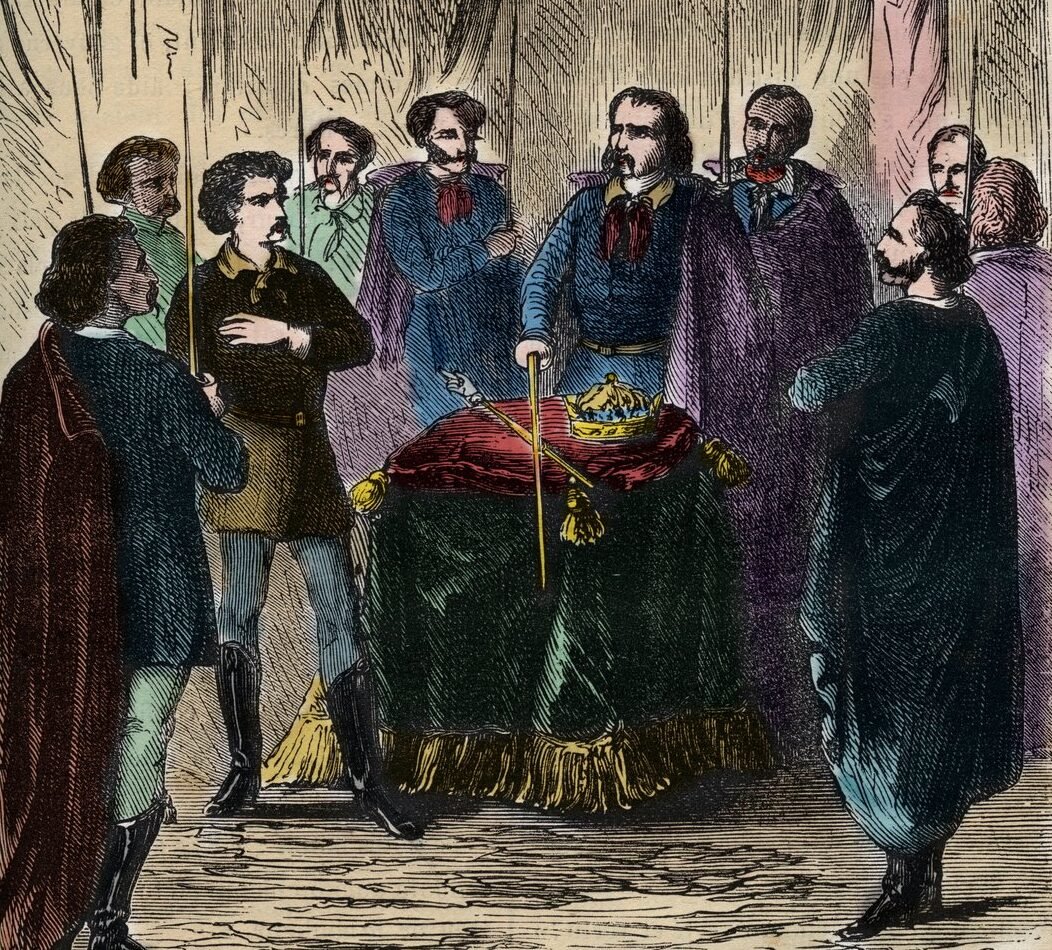
An engraved-style rendering of the founding gathering: the Bavarian Illuminati was established near Ingolstadt on May 1, 1776.
Growth was slow at first. The Bavarian Illuminati gained real momentum only after 1778, when it began actively recruiting through Masonic lodges across Bavaria and neighboring German states, and especially after 1780, when the well-connected Baron Adolph Knigge joined and brought organizational polish and dozens of new members with him. See how that reach is often misrepresented today in Myths and Popular Culture.
File No. II
Adam Weishaupt
Johann Adam Weishaupt (1748–1830) was the founder, chief ideologue, and eventual casualty of the Bavarian Illuminati, the order that made his name synonymous with conspiracy for the next two centuries. Full details on his life sit in our dedicated Adam Weishaupt profile.
Born in Ingolstadt in 1748, Weishaupt lost his father young and was raised under the guardianship of Johann Adam von Ickstatt, a reform-minded professor and Privy Councillor who steered him toward Enlightenment philosophy despite his Jesuit schooling. Weishaupt became the university’s first non-Jesuit professor of canon law in 1772 and was made dean of the law faculty in 1776, at just 27.
Within the order he took the code name “Spartacus,” a nod to the rebel who defied Rome, and organized his recruits into a rising scale of degrees: Novice, Minerval, and Illuminatus Minor at the base, with higher Masonic and “mystery” grades reserved for trusted senior members. He corresponded in cipher, dated letters by a private Illuminati calendar, and referred to cities and states by code names to protect the order from exactly the kind of exposure that eventually ended it.
When Bavaria’s 1785 edict named the Illuminati directly, Weishaupt fled Bavaria for the neighboring Duchy of Saxe-Gotha, where Duke Ernst II, himself sympathetic to the order, gave him refuge and a government position. Weishaupt spent the remaining 45 years of his life there, writing extensively in his own defense, and died in Gotha in 1830 at the age of 82 — never having revived the organization he founded.
File No. III
Organization and Membership
The Bavarian Illuminati ran less like a club than a graded training pipeline, and that structure is a large part of why it spread quickly and collapsed just as fast. See the full breakdown in Organization and Membership.
New recruits entered as Novices and, if they showed promise, advanced to Minerval and then Illuminatus Minor — grades focused on Enlightenment reading, moral self-improvement, and loyalty testing. Only a smaller inner circle progressed into the order’s upper, Masonic-influenced grades, which carried real organizational authority. Superiors monitored subordinates through written reports, and members were encouraged to inform on one another’s conduct, a system that built discipline but also bred the paranoia that later helped bring the order down from within.
Recruitment leaned heavily on infiltrating existing Masonic lodges rather than building from scratch, since lodges already supplied networks of educated, socially connected men. By its peak in the mid-1780s, historians’ estimates of total membership range roughly from 650 to 2,500 initiates, concentrated in Bavaria but reaching into Austria, Saxony, and other German-speaking states. Believed members included the astronomer Johann Bode, the writer and publisher Friedrich Nicolai, the philosopher Friedrich Jacobi, and the poet Friedrich Leopold zu Stolberg-Stolberg, alongside a number of minor nobles, officials, and academics.
The order’s operational life was brief: barely nine years passed between its 1776 founding and its 1785 suppression, and much of that window was spent building rather than acting on any coherent political program — a gap later conspiracy writers filled with speculation the historical record does not support.
File No. IV
Symbols and Traditions
Very little Bavarian Illuminati iconography survives from the order’s own era — most of what people associate with the name today was borrowed, retroactively, from other traditions. A deeper look lives in Symbols and Traditions.
The point within a circle. After Weishaupt was raised to Master Mason in 1777, the order adopted the simple geometric mark of a dot enclosed by a circle as an emblem, reflecting Masonic symbolic language of the time.
Code names and the classical calendar. Members took Latinized or classical pseudonyms — Weishaupt was Spartacus, Knigge was Philo — and the order used its own calendar and cipher alphabet to date and encrypt correspondence, standard tradecraft for 18th-century secret societies.
The Eye of Providence — a later graft. The single radiant eye now most linked to Illuminati imagery is a much older Christian symbol of divine watchfulness, in wide use in European religious art for centuries. It appeared on the Great Seal of the United States in 1782 and had no documented connection to Weishaupt’s order; the two became associated only later, as 19th- and 20th-century conspiracy writers retrofitted existing Masonic and religious imagery onto the Illuminati name.
The owl. Long a symbol of wisdom via the goddess Athena/Minerva, the owl attached itself to Illuminati lore largely because the order’s entry-level grade was named “Minerval” after her Roman counterpart, Minerva.
File No. V
Historical Timeline
A chronological overview of the Bavarian Illuminati, from the order’s founding to its suppression and the much longer afterlife that followed. See the full Timeline for a day-by-day breakdown.
May 1, 1776
The order is founded
Adam Weishaupt holds the first gathering of the Perfectibilists near Ingolstadt, Bavaria — the founding moment later known as the birth of the Bavarian Illuminati.
1777
Weishaupt joins the Masons
He is raised as a Master Mason in Munich, and begins reshaping the order’s structure and symbolism around Masonic ritual to aid recruitment.
1778–1780
Expansion through the lodges
The order spreads into Masonic lodges across Bavaria and neighboring German states; Baron Adolph Knigge joins in 1780 and accelerates recruitment sharply.
1782
Congress of Wilhelmsbad
Illuminati representatives engage with wider European Freemasonry at this major Masonic congress, extending the order’s reach and visibility.
1784
First Bavarian edict
Elector Karl Theodor bans all secret societies not authorized by the state, without naming the Illuminati specifically.
1785
Second edict and dissolution
A follow-up edict names the Illuminati directly. Weishaupt flees to Saxe-Gotha; raids on members’ homes recover internal papers, later published by the Bavarian government as proof of the order’s aims.
1797–1798
The conspiracy theory is born
Abbé Augustin Barruel in France and John Robison in Scotland publish books blaming the Illuminati for the French Revolution, launching the conspiracy tradition that has outlived the order itself.
19th–21st centuries
Cultural afterlife
The Illuminati becomes a recurring figure in fiction, film, music, and internet culture — almost entirely disconnected from the documented 1776–1785 organization.
File No. VI
Myths and Popular Culture
The “Illuminati” most people encounter today — all-powerful, secretly running world governments, banks, and entertainment — is a 19th- and 20th-century literary invention layered on top of the small, short-lived Bavarian Illuminati. More on the real record in Myths and Popular Culture.
The turn began with Barruel’s and Robison’s 1797–98 books, which recast the order as the hidden hand behind the French Revolution despite it having been dissolved roughly four years before the Revolution began (see Britannica’s overview of the Bavarian Illuminati for the documented record). That framing gave later writers a ready-made villain. In 1975, Robert Shea and Robert Anton Wilson’s Illuminatus! trilogy folded the order into a sprawling satirical conspiracy universe, cementing “the Illuminati” as pop-culture shorthand for hidden world control. Steve Jackson Games’ card game Illuminati (1982) and Dan Brown’s novel Angels & Demons (2000), later a 2009 film, carried the idea to a mass audience, casting the order as a shadowy force still operating today.
From there, internet culture did the rest: any symbol that resembles an eye, a triangle, or a pyramid is now routinely, and almost always incorrectly, read as an “Illuminati sign.” Historians who study the actual order find no documentary evidence connecting it to modern finance, entertainment, or global governance — the historical Illuminati collapsed as a functioning organization in 1785 and left no verified successor.
File No. VII
The Illuminati Around the World
The historical Bavarian Illuminati operated almost entirely within German-speaking Central Europe. Its reputation, however, went global — carried first by 1790s conspiracy books and later by film, fiction, and the internet. Each entry below separates what the historical record actually shows from what is modern legend.
Germany
Historical homeland
Germany is not a footnote to this story — it is the story. The Bavarian Illuminati was founded in Ingolstadt, headquartered in Bavaria, and spread through Masonic lodges in Munich and other Bavarian and German cities before Elector Karl Theodor’s 1784–85 edicts dissolved it. Surviving Illuminati papers, seized in police raids, remain the primary sources historians use today (see HISTORY’s account of the order’s origins).
France
Documented indirect link
The Comte de Mirabeau, later a leading figure of the French Revolution, is reported to have had contact with Illuminati circles while in Berlin in the mid-1780s. That thin, disputed connection became the seed of a much larger claim: Abbé Barruel’s 1797 book argued the order had secretly engineered the entire Revolution. Mainstream historians reject that causal claim, given the order’s collapse years before 1789, but it remains the origin point of nearly all later Illuminati conspiracy writing.
United Kingdom
Conspiracy theory’s entry point
No lodge of the Bavarian order is documented on British soil. Britain’s role was as amplifier: Scottish physicist John Robison’s 1797 book Proofs of a Conspiracy introduced Illuminati fears to the English-speaking world, directly shaping how the story reached America the following year.
United States
Conspiracy panic, not a chapter
No historical evidence places an actual Illuminati lodge in America. What did reach the US was the panic: in 1798, Boston minister Jedidiah Morse preached a series of sermons built on Robison’s book, warning that the Illuminati had infiltrated American Freemasonry. President George Washington, pressed on the claim by correspondent G. W. Snyder, wrote back that he did not doubt Illuminati and Jacobin doctrines had reached the US, but stopped short of saying American Masonic lodges had propagated them as institutions. That correspondence remains the closest thing to an official 18th-century American brush with the order — a debate about influence, not a documented branch.
Canada
No historical record
There is no documented Illuminati presence in Canada during the order’s 1776–1785 existence, nor in the 1798 panic that touched New England. Canadian references to the Illuminati are a purely modern phenomenon, part of the same 20th- and 21st-century pop-culture and internet conspiracy wave found across the English-speaking world.
Australia
No historical record
Founded in 1788, the British colonies in Australia post-date the Illuminati’s suppression by three years, making any historical connection a chronological impossibility. Australian Illuminati references belong entirely to modern conspiracy culture, not documented history.
Italy
No confirmed lodge
No verified Bavarian Illuminati lodge has been documented in Italy. Its modern association with the country comes mainly from fiction — Dan Brown’s Angels & Demons is set largely in Rome and Vatican City — rather than from any 18th-century paper trail.
Netherlands
No confirmed lodge
Dutch Masonic lodges were active in the same Enlightenment-era period, but no historical evidence connects them to Weishaupt’s order. Claims placing the Illuminati in the Netherlands rest on modern internet conspiracy material rather than primary sources.
Switzerland
Adjacent Enlightenment network
Switzerland sat inside the broader German-speaking Enlightenment world the Illuminati drew on, and Geneva in particular was a major hub of Enlightenment philosophy in this period. No confirmed Illuminati lodge has been documented on Swiss soil, but Swiss thinkers and Masonic networks were part of the same intellectual current the order tapped into elsewhere in the German-speaking sphere.
File No. VIII
Illuminati Compared
The Bavarian Illuminati is often confused with, or assumed to be an extension of, other secret societies. Here is how the documented record actually distinguishes them.
Bavarian Illuminati vs. Freemasonry
Bavarian Illuminati
Freemasonry
Founded
1776, Ingolstadt, Bavaria
Traditions trace to medieval stonemason guilds; modern form organized from 1717, England
Core aim
Spread Enlightenment reason, curb Church and monarchical power
Moral self-improvement, fraternity, charitable work
Structure
Graded, secretive, grafted onto existing Masonic lodges for recruitment
Graded lodge system, largely non-political by charter
Status today
Dissolved 1785; no verified continuation
Still active worldwide as a fraternal organization
Relationship
Infiltrated Masonic lodges to recruit members
Was the recruiting ground the Illuminati used, not its creator
Bavarian Illuminati vs. Rosicrucians
Bavarian Illuminati
Rosicrucians
Founded
1776, verifiable historical founder
Manifestos appeared 1614–1616; founder “Christian Rosenkreuz” is likely legendary, not historical
Orientation
Political and philosophical, Enlightenment rationalism
Mystical and esoteric, alchemical symbolism
Evidence base
Confirmed by seized statutes, correspondence, and government edicts
Never conclusively shown to be an actual organization in 1614
Historical overlap
Weishaupt drew on Rosicrucian-style grade systems for structure
Predates and partly inspired Illuminati organizational style
The Historical Illuminati vs. the Pop-Culture “Illuminati”
Historical Illuminati (1776–1785)
Pop-culture “Illuminati”
Scope
A few hundred to a few thousand members, mainly in German-speaking Europe
Portrayed as a global network controlling governments, banks, and media
Lifespan
9 years, then suppressed
Portrayed as continuously active for 250+ years
Evidence
Government records, seized papers, contemporary correspondence
Almost entirely fiction, film, music imagery, and internet speculation
Origin of the modern version
—
Traces to Barruel (1797) and Robison (1798), popularized by 20th-century novels, games, and film
File No. IX
Frequently Asked Questions
Was the Illuminati a real organization?
Yes. The Bavarian Illuminati was a documented secret society founded by Adam Weishaupt on May 1, 1776, in Ingolstadt, in the Electorate of Bavaria. It left behind statutes, internal correspondence, and government records, and was formally banned by Bavarian edicts in 1784 and 1785.
Does the historical Illuminati still exist today?
No verified version of it does. The original order was dismantled by 1785 and no continuous organization has been documented since. Various modern groups have adopted the name, but historians have found no evidence that any of them are genuine continuations of Weishaupt’s order — they are separate, self-created uses of a historical brand.
When exactly was the first Illuminati meeting held?
On the night of May 1, 1776, Adam Weishaupt held the founding meeting of what would become the Bavarian Illuminati near Ingolstadt, Bavaria. Members initially called themselves Perfectibilists; the name “Illuminati” took hold soon after.
Did the Illuminati cause the French Revolution?
Most historians say no. The claim originates with Abbé Augustin Barruel’s 1797 book, published after the Revolution, and it overlooks that the Bavarian order had already been suppressed roughly four years before the Revolution began in 1789. No primary evidence connects the order’s leadership to French revolutionary events.
Is the eye symbol on the US dollar bill an Illuminati symbol?
No. The Eye of Providence is a centuries-old symbol of divine watchfulness used widely in Christian art before 1776. It was added to the Great Seal of the United States in 1782, and no documented link ties it to Weishaupt’s order.
What does the word “Illuminati” actually mean?
Illuminati is the Latin plural of illuminatus, “enlightened one.” It reflects the Enlightenment-era self-image of the order’s members as rational, educated reformers.
How many members did the order have at its peak?
Estimates vary by source, but most historians place peak membership somewhere between roughly 650 and 2,500 initiates, concentrated in Bavaria and neighboring German-speaking states.
Why did Bavaria ban the Illuminati?
Elector Karl Theodor issued edicts in 1784 and 1785 banning secret societies not sanctioned by the state, naming the Illuminati specifically in the second. Authorities viewed its secrecy, its infiltration of Masonic lodges, and its anti-clerical, anti-monarchical ideas as a threat to civil and religious order.
Is the Illuminati the same thing as the Freemasons?
No. The Illuminati was a distinct order that used existing Masonic lodges as a recruiting ground and borrowed some of their ritual structure, but Freemasonry predates the Illuminati, had a different purpose, and continues today as an active fraternal organization worldwide.
The First Illuminati Meeting
On May 1, 1776, Adam Weishaupt held the first meeting of the society that would later become known as the Bavarian Illuminati in Ingolstadt, Bavaria. This gathering marked the official beginning of the organization